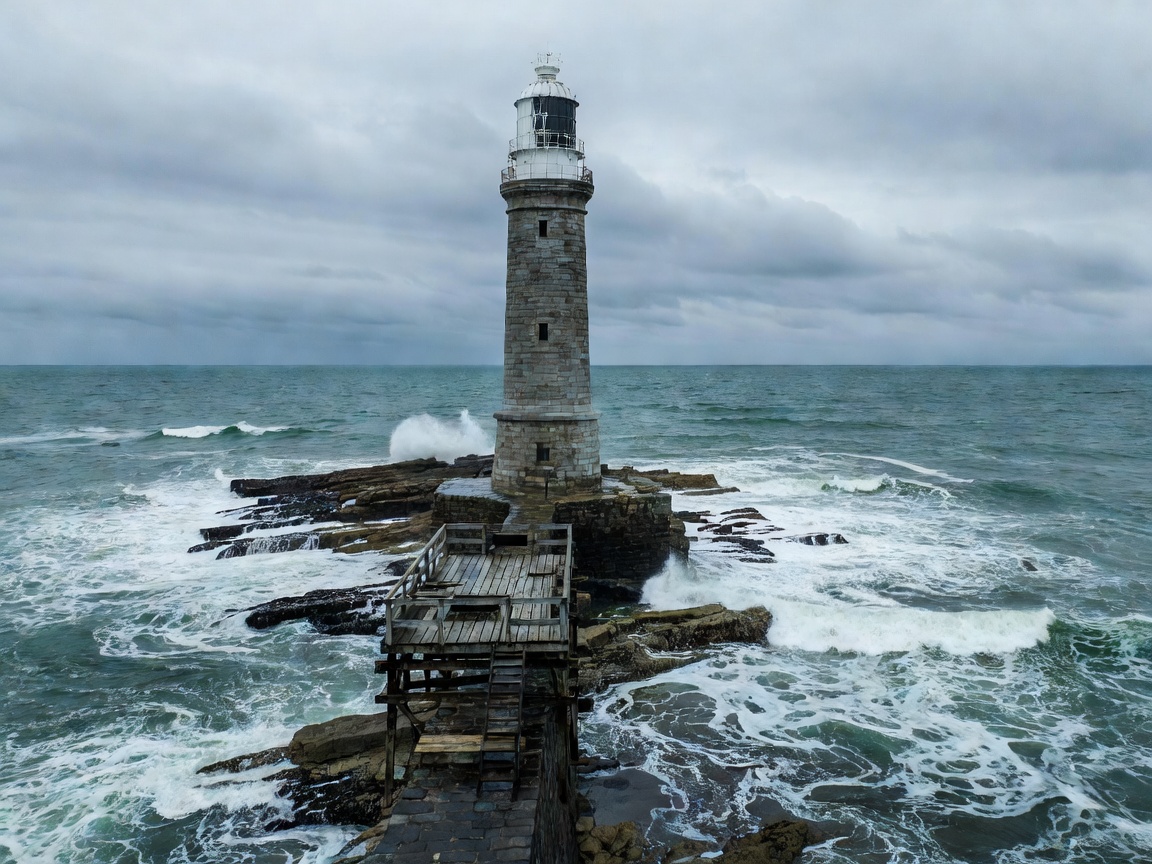
The real problem at Bell Rock
Bell Rock, off the east coast of Scotland, is dangerous for a simple reason: the reef is submerged for much of the tidal cycle. A hazard that disappears under water is harder to mark and harder to build on. Unlike a more consistently exposed platform, Bell Rock does not offer a normal site. It offers intervals. Construction therefore depends on the disciplined use of short windows, the readiness of materials and labour, and a design that can advance in small but secure increments.
This is why Bell Rock is so useful for understanding lighthouse engineering. It reveals that the tower is only the visible tip of a larger system. Supply vessels, temporary accommodation, signalling between work parties, preparation of stone and strict organisation of tasks all become structural factors. If one course is delayed, the tide does not wait out of courtesy.
Robert Stevenson and the importance of planning
Bell Rock is closely associated with Robert Stevenson, and rightly so. His achievement was not merely to oversee a handsome stone tower. It was to translate the lessons of earlier rock lighthouses, especially Eddystone, into a construction strategy suited to a Scottish tidal reef. That meant choosing methods that reduced uncertainty. Stone had to arrive ready or nearly ready. Joints had to be exact. Crews had to know which operation came next before they landed on the rock.
On a normal building site, delay costs money and patience. At Bell Rock, delay also costs the site itself, because the sea takes it back. That makes planning part of the structure. The Northern Lighthouse Board, as the responsible authority, needed an enterprise that was administratively reliable as well as technically ambitious. The result shows how institutional capacity and engineering judgment support one another.
Why the masonry matters so much
Bell Rock borrows from the mature marine masonry tradition developed after Eddystone, but it is not just a copy. The stonework had to be cut and assembled so that the tower behaved as one body. Interlocking courses and careful fitting help resist displacement under impact and long-term movement. This matters offshore because water does not strike once. It loads, withdraws, returns and exploits weakness at edges and joints.
The lower courses are especially instructive. They speak the language of permanence: large blocks, firm seating on the prepared rock, and a profile that makes wave contact less punishing than a sheer cylinder would. To say the tower is massive is true but incomplete. Mass without good geometry can still be clumsy. Bell Rock succeeds because its mass is organised.
There is a practical cost to this approach. Heavy stone and fine cutting increase labour, transport demands and build time. Yet on a remote reef, an apparently cheaper solution may prove false economy if it cannot survive. Bell Rock therefore illustrates a recurring lighthouse trade-off: invest more at the fabric stage to reduce the chance of catastrophic maintenance problems later.
How a tidal build changes labour and living conditions
Rock lighthouse history can sound abstract if discussed only in terms of profiles and courses. Bell Rock brings the human side back into view. Men working there had to live within the rhythm of sea access, weather and exposure. Temporary structures and support arrangements were not incidental comforts; they were enablers of progress. Offshore building requires a floating and shore-based support network, because the reef itself cannot carry the entire burden of the enterprise.
This affects engineering decisions. If a task needs delicate fitting, it may be prepared as far as possible away from the rock. If a course must be completed within a narrow period, everything has to be staged for immediate use. The design of the finished lighthouse is thus shaped by constraints long before the lantern is installed.
Bell Rock as an optical station, not only a building
Once complete, Bell Rock had to function as a signal in the North Sea approaches, not merely as proof that construction was possible. The lantern, optic and characteristic of the light were central to that duty. A lighthouse must be seen, but it must also be distinguished. Mariners need to know which light they are reading. That requirement links optical apparatus to the wider network of coastal lights managed by the authority.
Over time, developments in lens design, fuel systems and later electrical service changed the operational workload. Yet a place like Bell Rock never becomes simple. Salt, vibration and access difficulties continue to shape maintenance. Automation can reduce resident staffing, but it does not make the reef less tidal or the tower less exposed. It changes who visits and how often, not the seriousness of the environment.
Why Bell Rock remains a benchmark
Bell Rock endures in engineering discussion because it joins three things cleanly: a harsh site, a rigorous construction method and an enduring finished work. If Eddystone is the famous school of trial and revision, Bell Rock is the demonstration that the lessons can be planned and executed with extraordinary discipline. It shows the Northern Lighthouse Board not simply maintaining aids to navigation, but building institutional confidence in marine works of the highest order.
The broad lesson is straightforward. Offshore lighthouses are never only about design intent. They are about whether intent can be carried through the sea, the tide and the calendar of actual working days. Bell Rock answers yes, but only because every part of the process was treated as engineering.