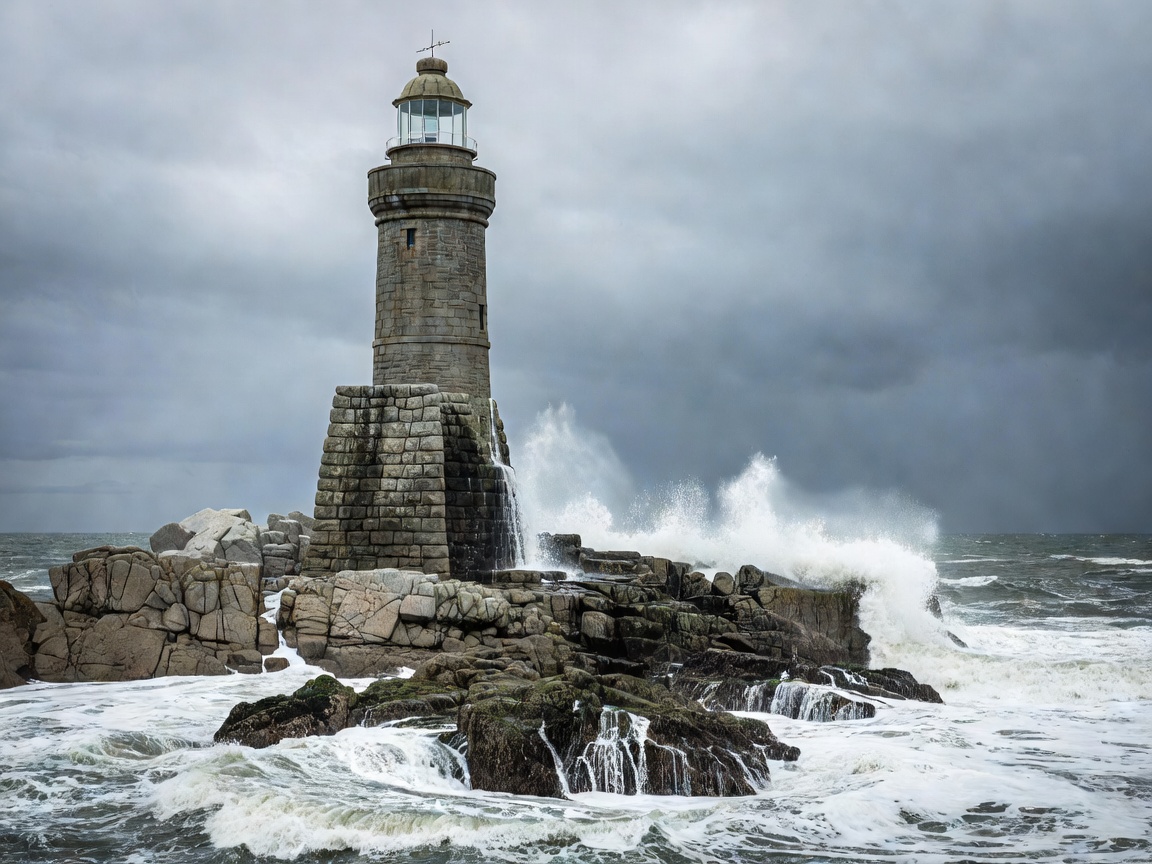
Why Eddystone is such a severe test
The Eddystone Rocks sit where Atlantic weather and Channel traffic combine to punish bad design. The engineering problem begins with the site itself. A low rock platform gives very little forgiveness: foundations are difficult to prepare, working windows are limited by sea state, and the completed tower must cope with breaking water that hits low, climbs high and strikes from more than one direction. A cliff-top lighthouse can use height and distance as its first defence. Eddystone cannot. Its tower has to engage directly with the sea.
That pressure is why Eddystone appears again and again in lighthouse history. It is less a single monument than a sequence of solutions. The value of the sequence is comparative. One can see what happens when a tower relies on carpentry, what happens when flammable construction meets lamp and fuel, and what happens when masonry is shaped and locked together with the sea in mind rather than against it in a simple vertical stack.
From precarious structure to marine masonry
The early Eddystone lighthouse associated with Henry Winstanley is often remembered for boldness, but boldness and durability are not the same thing. On a reef, exposed elements, complicated form and insufficiently marine logic all work against survival. John Rudyard’s later wooden lighthouse simplified the shape and improved the practical result, yet the material still carried an obvious weakness. A lighthouse is a fire risk by nature when illumination depends on flame and fuel. On a remote rock, firefighting options are poor and evacuation worse.
The decisive turn came with John Smeaton’s masonry lighthouse. The point was not merely to change wood for stone. Smeaton developed a coherent marine form: broad where the sea strikes hardest, curving upward in a way often compared to the trunk of an oak. The comparison is memorable, but the engineering reason is better than the metaphor. A battered profile helps distribute force, reduces vulnerable projections and gives the tower a stable visual and structural base. Just as important, the stones were cut to interlock. A reef lighthouse cannot be treated like an inland wall with mortar doing the persuasive work. Individual courses need mechanical relationship as well as bedding.
That interlocking principle became one of the great inheritances of Eddystone. It influenced later rock lighthouses far beyond the reef itself, including towers such as Bell Rock and Skerryvore. Once designers understood that the sea would test not only the mass of masonry but the continuity of the whole assembled shell, jointing became a central issue rather than a finishing detail.
Foundation and profile: the trade-off that matters
There is a temptation to discuss famous lighthouses from the lantern down. At Eddystone it is better to think from the rock upward. The foundation determines everything above. A narrow footprint might save effort at the start, but it leaves less room for a heavy lower body and less resistance to the overturning effect of repeated wave impact. A broader seating and larger base consume labour and stone, yet they buy calmness into the whole structure.
Profile is the visible expression of that bargain. A straight-sided shaft can be elegant, but elegance is a weak defence against green water. The classic Eddystone-type curve is not decorative flourish. It places more masonry low down, improves the tower’s relation to the rock and gives the sea fewer abrupt ledges to exploit. It does not make the wave disappear; it makes the tower better prepared to receive it.
There is also a human consequence. Inside a rock lighthouse, wall thickness affects room shape, stair geometry, storage and service routes. Offshore towers are engineering works first, but they still house equipment and, in the staffed period, people. A profile chosen for hydrodynamic sense produces awkward interiors, small lower rooms and a strong vertical sequence. At Eddystone that compromise is accepted because survival comes first.
What Eddystone tells us about optics and operation
The tower grabs most attention, but Eddystone also shows that a lighthouse is a signalling device with a support structure attached. The lantern has to be protected from spray, the glazing has to withstand harsh conditions, and the light must remain distinguishable to mariners who may already see several coastal lights. Over time, changes in fuel, burner design, lenses and power supply reduced some of the burdens on the station. Better optics could do more with the light source available. Electrification and automation later reduced the need for resident keepers.
Still, automation does not erase the logic of the reef. Remote monitoring can report lamp faults and electrical anomalies, but it cannot change the weather or simplify access for maintenance crews. Eddystone therefore helps explain a broader truth: technology may alter the operational model, yet extreme sites continue to demand robust fabric and careful inspection routines.
Why Trinity House keeps appearing in the discussion
Trinity House matters here not as a badge but as an operating authority shaped by difficult stations. Eddystone contributed to institutional learning. Decisions about rebuilding, materials, procurement and maintenance were not abstract. They were tied to wreck risk, navigation need and the hard evidence of what previous towers had endured. That is one reason Eddystone has such long afterlife in engineering writing. It provided an early and public demonstration that a lighthouse authority had to be part mariner, part builder and part systems operator.
If you want one lesson from Eddystone, it is this: good lighthouse design is cumulative. The tower that survives is rarely the first idea. It is the idea after failure, revised through material knowledge, site knowledge and operational discipline.