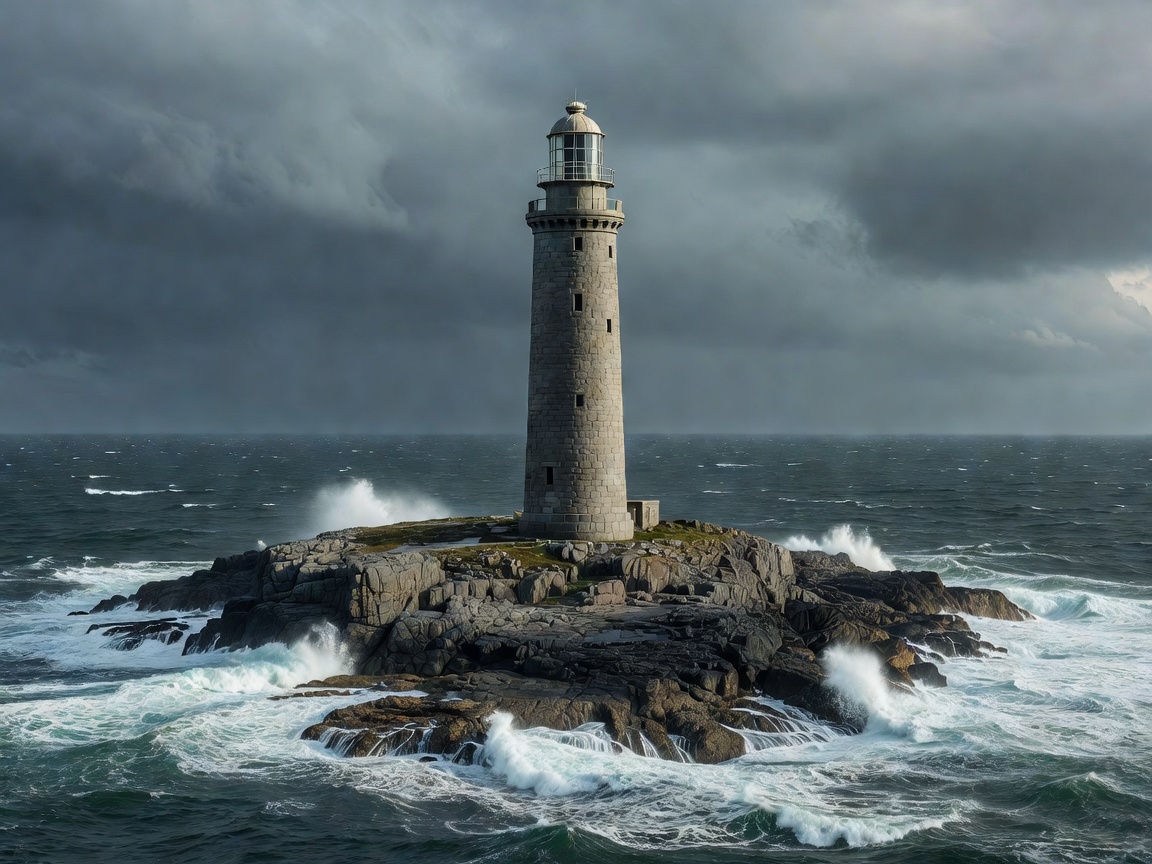
What makes Skerryvore different
Skerryvore belongs to the same family as Eddystone and Bell Rock, yet it feels like a later and more assured statement. The site lies in an Atlantic setting where swell, isolation and exposure raise every difficulty. By the time work there was conceived and carried through, the principles of rock lighthouse construction were better understood. The challenge was not to invent from scratch but to apply the mature tradition at a scale and remoteness that still pushed crews and material systems hard.
This is why Skerryvore is so often treated with a certain reverence. It appears to say that offshore masonry can answer even this. But reverence is less useful than analysis. The tower succeeds because it combines heavy lower geometry, disciplined stonework, serious foundations and a practical acceptance that marine works must be overbuilt compared with ordinary structures.
Granite, mass and the meaning of scale
Granite is central to the character of Skerryvore. Offshore, dense and durable stone carries obvious advantages, though it also raises transport and handling difficulty. Choosing granite is not a romantic choice about nobility of material. It is a choice about strength, weathering and long life where repair is expensive. Every additional burden at the construction stage may save repeated burdens later.
Scale at Skerryvore should also be read carefully. A tall tower can increase focal height and improve conspicuity, but height without adequate base design would be vanity. The tower’s lower body does the argumentative work. Its mass anchors the structure visually and mechanically. The upward taper then reduces unnecessary weight higher up while preserving stability and the familiar wave-shedding logic seen in the best rock towers.
The interior consequences follow. Thick walls, narrowing chambers and a concentrated vertical organisation all reflect the outer form. Rock lighthouses do not offer generous plan freedom. Rooms fit inside the structural requirement, not the other way round. That can seem austere, but it is part of the honesty of the type.
Construction effort in a western sea area
Skerryvore was no gentle extension of previous work. West coast weather and distance complicate provisioning and timing. Material supply, landing arrangements and crew management matter immensely when the worksite is isolated and the sea can waste days without apology. In that sense, Skerryvore confirms Bell Rock’s lesson: organisation is structural. A stone tower offshore is assembled not only from blocks but from transport routines, temporary works and sequences that must hold together over long periods.
The Northern Lighthouse Board again appears as the relevant institutional frame. Offshore projects of this scale require sustained administrative capability. Funding, design continuity, supply management and later maintenance planning all sit behind the visible tower. It is a mistake to think of the lighthouse authority as simply changing lamps. On sites like Skerryvore, the authority is sponsor, operator and steward of a major marine asset.
Optics, lantern and signal identity
However imposing the masonry, the station fails if the light signal is poor. At Skerryvore the lantern and optic had to serve a sea area where weather can degrade visibility and where recognition matters as much as raw brightness. A good lighthouse characteristic gives mariners a distinct pattern they can separate from neighbouring aids. That requirement shaped apparatus choices over time as lighting technology improved from earlier fuel systems through later electrical arrangements.
One useful point here is that impressive towers often outlast several generations of optical technology. The stone shell may remain broadly the same while light source, lens arrangement, power supply and control systems change. Skerryvore therefore helps explain the layered nature of lighthouse history. The exterior can suggest one era while the service equipment inside belongs to several others.
Automation and the afterlife of the staffed station
As with other major lights, the move toward automation altered daily practice more than it altered the essential seamark role. Remote supervision, improved lamp reliability and reduced on-site staffing shifted the station from continuous occupation to periodic technical attention. Yet stations designed for keepers do not instantly shrink when keepers go. Ancillary buildings, stores and living accommodation may remain as substantial reminders of earlier operation.
Automation also changes the meaning of access. Where once regular human presence justified robust domestic provisioning, later maintenance visits place greater emphasis on safe, efficient intervention: get in, inspect, repair, leave. Harsh marine exposure still dictates the schedule. The sea has never shown much respect for advances in telemetry.
Why Skerryvore still stands as a touchstone
Skerryvore is a touchstone because it demonstrates the fullest ambitions of stone lighthouse design before the balance of technology shifted. Later eras could light coasts with different materials, different power systems and less dependence on permanent resident staff. But if the question is how far nineteenth-century marine masonry could be developed in Britain and Ireland, Skerryvore is part of the answer.
It is not merely beautiful engineering. It is explicit engineering. The tower tells you what it is for: to keep enough weight low, enough order in the masonry and enough dignity in the lantern to stand in an Atlantic place and continue signalling through change. That directness is probably why it remains so compelling.